Glen Beaumont
The Dark HalfGlen Beaumont is Thad Beaumont’s father, a dismissive and physically abusive presence whose response to Thad’s childhood medical crisis turns a frightening diagnosis into a portrait of the danger and power inside the family. His impatience with his son and his wife stands in sharp contrast to their concern, establishing a domestic history in which fear is met not with care but with contempt.
Identity and Family Background
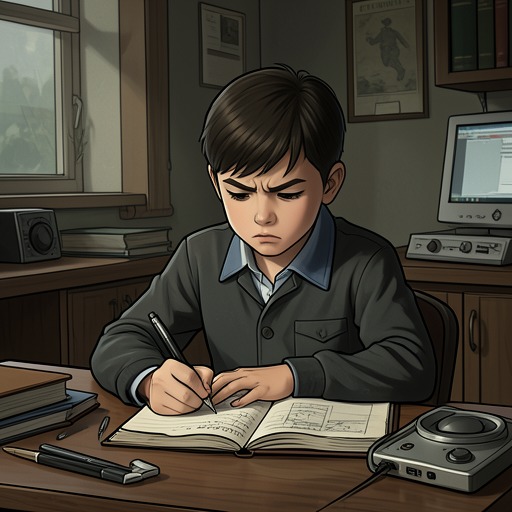
When Thad is introduced as a quiet, earnest boy who often trips over his large feet and cannot seem to hold onto things, his mother gathers him into her arms and kisses him. Glen, seated in his easy chair, answers the news of his son’s promise with a demand to know why it had not earned him money. He then sarcastically compares the boy to Ernest Hemingway and asks for a beer. The exchange makes Glen’s priorities plain: he treats his child’s achievement as a failed source of income and reduces the moment of maternal affection to an inconvenience.
The Medical Crisis
During the examination of Thad’s headaches and flashing-light episode, a doctor asks whether he heard birds while seeing the light. Thad says he did not and is mystified by the question. After Thad has been sent to the outer waiting room, Glen dismisses the problem as nerves, calling his son a bundle of them. The doctor, by contrast, considers migraine and describes Thad as unusually intense; Thad’s mother agrees with a trace of approval. Glen’s quick diagnosis substitutes irritation for attention even as the adults are trying to understand what has happened to the child.
Conflict with the Doctors
When Pritchard shows the Beaumonts an X-ray with a vague shadow circled in yellow wax pencil, Glen refuses the uncertainty back onto the doctor, telling him that identifying it is the doctor’s job. Pritchard responds dryly. Glen then reports that Thad’s mother said the boy seemed to have pitched a fit, keeping the conversation focused on the event’s appearance rather than its cause. When Pritchard explains that the sudden headaches and absence of previous seizures suggest a brain tumor, probably still small and hopefully benign, Glen asks whether the doctor means to cut Thad’s brains. The question is blunt enough to sound like a challenge rather than a request for reassurance; Pritchard answers that he would call for exploratory surgery.
Violence and Narrative Significance
Glen’s response to the diagnosis is set against his wife’s silent weeping. She stands beside him, crying into a handkerchief without making a sound; the narration connects that silence to years of domestic training, explaining that Glen’s fists were fast and hurtful, though they almost never left marks. After twelve years of such sorrow, she may no longer have been able to cry aloud. The scene therefore reveals more than Glen’s callousness during his son’s crisis: his wife’s restrained grief bears the trace of a household shaped by his violence. His place in Thad’s background is defined by this contrast between the child’s vulnerability, the mother’s suppressed distress, and the father’s contemptuous control.